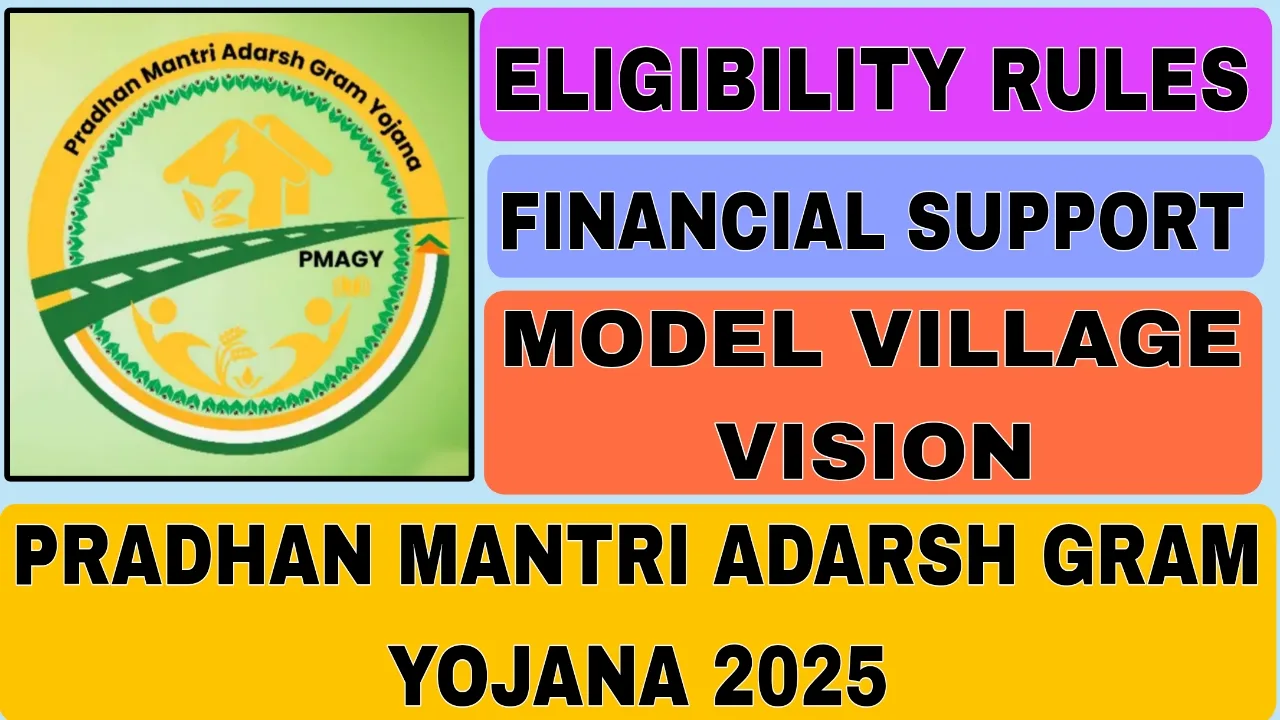
The Pradhan Mantri Adarsh Gram Yojana – PMAGY 2025 implemented by the Ministry of Social Justice and Empowerment, Government of India is an important scheme that converts villages into model villages with equal access to essential services, infrastructure and livelihood opportunities. This scheme was Launched initially as a pilot in 2009–10 and this scheme aims to bridge development gaps in villages where Scheduled Caste population is 50 percent or more. Under this scheme each selected village receives up to Rs 20 lakh as gap-funding to improve basic infrastructure such as roads, sanitation, clean drinking water, education, healthcare, electricity, housing and livelihood facilities. The development model is based on convergence meaning PMAGY integrates and optimizes multiple central schemes such as PMAY-G, MGNREGS, Ujjwala Yojana, Swachh Bharat Mission, Ayushman Bharat and Jal Jeevan Mission to create sustainable village progress. The scheme is implemented through a structured planning mechanism involving the Gram Panchayat, Village Convergence Committees and District Administration. Villages selected under PMAGY undergo baseline surveys, development planning, fund allocation, and continuous monitoring across 50+ measurable indicators. Once a village achieves 70 or more points.
Key Highlights
| Key Point | Details |
|---|---|
| Organization Name | Ministry of Social Justice & Empowerment |
| Scheme Name | Pradhan Mantri Adarsh Gram Yojana 2025 |
| Funding Support | Up to Rs 20 lakh per village |
| Join WhatsApp | Click Here |
| Official Website | www.pmagy.gov.in |
What is Pradhan Mantri Adarsh Gram Yojana (PMAGY)?
PMAGY focuses on holistic socio-economic development of SC-majority villages by ensuring they meet the standards of an Adarsh Gram An Adarsh Gram is expected to have:
- Universal access to basic amenities such as water, sanitation, electricity, and housing.
- Improved education and healthcare facilities for all residents.
- Sustainable livelihood opportunities and enhanced skill development.
- Clean environment, proper waste management, and digital connectivity.
- Social inclusion, equality, and community participation in development.
The scheme encourages village-level ownership, accountability, and measurable improvements through structured development planning.
PMAGY 2025 Features & Benefits
| Feature | Details |
|---|---|
| Scheme Launch Year | 2009–10 (Pilot Phase) |
| Financial Assistance | Rs 20 lakh per village – gap funding |
| Pilot Coverage | 1,000 villages across 5 states |
| Development Approach | Convergence of central & state schemes |
| Planning Mechanism | 5-year Village Development Plan (VDP) |
| Monitoring | 50+ parameters across 10 development domains |
Major Benefits for Villages
- Strengthening village connectivity through roads, street lighting, and public spaces
- Ensuring access to safe drinking water and sanitation
- Improving healthcare infrastructure, including Anganwadi and wellness centres
- Increasing school enrolment, digital literacy, and educational facilities
- Promoting livelihood opportunities and skill development programs
- Enhancing social security coverage for vulnerable communities
- Encouraging clean fuel usage, renewable energy adoption, and environmental sustainability
Eligibility Criteria for PMAGY 2025
To qualify under Pradhan Mantri Adarsh Gram Yojana, a village must meet specific government-defined criteria:
- The village should have 50% or more Scheduled Caste population (40% in special cases as per state relaxation).
- Must be a recognized village in the latest Census.
- Should have a minimum population of around 500.
- Villages already developed under earlier PMAGY phases cannot be reconsidered.
- Priority is given to villages with low infrastructure availability or higher socio-economic gaps.
Implementation Workflow: How PMAGY Works
Unlike individual schemes, PMAGY is village-based. Here is how the entire process unfolds:
1. Village Identification
The Gram Panchayat identifies villages with 50%+ SC population and proposes them for inclusion.
2. Formation of Committees
A Village Convergence Committee (VCC) is created, involving Panchayat members, social workers, and local officials.
3. Baseline Survey & Data Collection
Officials conduct a detailed survey covering essential indicators related to – water supply, roads and housing, electrical, health , sanitation, agriculture and social inclusion.
4. Preparation of Village Development Plan (VDP)
A 5-year action plan is created with required works, estimated costs, and funding sources from various schemes.
5. Approval & Fund Release
The plan is submitted to the District Level Convergence Committee (DLCC) for approval.
Once approved, ₹20 lakh gap-funding is released to the implementing agency.
6. Execution of Development Works
The village begins implementing approved works such as:
- Building roads and community toilets
- Installing solar street lights
- Enhancing water supply and drainage
- Constructing Anganwadi centers
- Upgrading schools and digital centres
- Improving healthcare access
7. Monitoring & Evaluation
The Gram Panchayat sends periodic progress reports.
The district monitors projects across 50+ indicators.
8. Declaration as Adarsh Gram
A village is certified as a model village when it:
- Scores 70 or above in evaluation
- Achieves Open Defecation Free (ODF) status
- Meets essential development norms
Documents Required for PMAGY Implementation
Villages selected for PMAGY must submit the following documents:
- Approved Village Development Plan (VDP)
- Bank account details of the implementing agency
- Convergence Committee details (names, designations, contact numbers)
- Baseline survey reports covering – Drinking water & sanitation, Health & nutrition, roads and electricity.
- Utilization certificates in prescribed formats
Frequently Asked Questions
1. Who can apply for PMAGY 2025?
Individuals cannot apply. The scheme is implemented at the village level through the Gram Panchayat and District Administration.
2. How much financial assistance is provided under PMAGY?
Each selected village receives ₹20 lakh as gap funding for development activities.
3. What is the main objective of Pradhan Mantri Adarsh Gram Yojana?
The primary goal is to develop SC-majority villages into sustainable, inclusive, and well-equipped model villages.
Important Links
Official Website www.pmagy.gov.in